
Have you ever dreamt about changing seats with Lewis Hamilton or Sebastian Vettel? Have you asked yourself the question: “Why do some drivers in the Formul
Have you ever dreamt about changing seats with Lewis Hamilton or Sebastian Vettel? Have you asked yourself the question: “Why do some drivers in the Formula 1 become champions, and others don’t?” Have you ever felt the need to excel and become better than your competition?
The journey to becoming a successful driver in the Formula 1 resembles the journey of becoming an innovation champion. The most innovative organizations face similar hurdles that they have to overcome. Let’s analyze what the foundations are, and what is needed to becoming an innovation champion among tough competition.
Where to start? - The vision
Every story has a starting point. And every success story starts with a vision – what do you want to achieve? What is your plan to achieve these goals? What resources are available to you, and which ones do you need to become successful? Which team is supporting you, and which team do you need to get the results you are looking for? What mindset do you need to have as a driver to become a champion, and what mindset should your employees embody to think creatively? What environment should be in place to enable your employees to think and act creatively, and what environment do you need to succeed?
All these questions need to be answered before you start executing. The most successful innovators started with a vision and a plan to implement it. Without structure your approach might not achieve the impact you are striving for. The greatest drivers in the Formula 1 had a long term strategy and started their careers early on. Support from their families was often crucial, and the same is true for innovation programs. Support from Middle- and especially Senior-Management has a fundamental impact on your success.
The foundation - A great car
A F1 driver requires the proper technical foundation to be able to race the competition. A race car that embodies all features and functionalities enables its driver to unleash his or her potential. Without it all efforts are meaningless, and even with the greatest talent and skills the driver will not be able to turn them into a successful career. But ultimately a car can only be used as a tool – a great car cannot make everybody a champion, but a talented driver can only become a champion by utilizing a great car.
The same is true for innovation programs. Only a flexible and powerful platform as their core foundation can transform ideas, comments and votes into the business value an organization is looking for. A great platform alone cannot create change and desired ROIs, but a carefully planned and ambitiously executed innovation program, based on a strong foundation, can turn any organization into an innovation champion.
Master the technique - Try to make your first laps without crashing the car
Before you can start your first race you have to understand your car and get a feeling of how it works, otherwise you will crash it in your first curve. Get a proper training and get all the knobs, buttons and pedals explained to you. Understand how the car behaves, and how you can turn all its features and characteristics into your advantage. Ask yourself: How can I make the best out of it?
Innovation programs are typically tested internally with a peer group, usually with 20-50 key users (Subject Matter Experts or similar). How does this peer group react to a new platform and process? What is their feedback, what are the positive and negative aspects they highlight? Successful innovation programs incorporate such feedback prior to rolling it out. It is important to adjust important parameters so that your innovation program is based on a foundation that fits your social culture and your vision.
Beat your expectations - Try to reach your own goals first
You have mastered the first step by being able to drive your car without crashing it. What now? It is essential to first beat your own expectations. It is not about the competition yet, it is more about getting first results that only matter to you. Set goals that are only interesting to you – “driving the test-track in less than 3:30min” could be an example.
A typical first campaign to test innovation programs with is looking for tactical goals. It is about communicating the process and getting audiences “hooked” to the idea of online collaboration and social activities on online platforms. It is the prerequisite to solving actual business challenges later on. Try to run your first real campaign with tactical topics - challenges that do not require special knowledge and that all employees are interested in are good candidates. They usually do not deliver business value your top management is looking for, but they explain how processes work and motivate audiences to participate. Good examples could be to ask if the cafeteria menu needs to be changed, or how to enhance the parking situation (PS: Send me an email and let me know what worked for you…).
Time to get the gloves off – let’s race!
Let’s be clear: You will not necessarily win your first real race, maybe even not your second or third. Actually your primary goal will not be to win your first race as quickly as possible. You will probably start from the last position in the classification. You will simply not be able to beat the rest of the competition, because you…
…don’t know the race tracks yet
…don’t know the behaviors of the other racers
…are simply inexperienced to drive a race car in a competitive environment
The same applies for innovation programs in early stages. It typically is not your first goal to solve the biggest strategic challenge of your organization first. This is related to the fact that you will only have…
…limited insights into the behaviors of your employees
…limited experience in running and managing campaigns that have an impact on your business
…limited support by your management
Instead of targeting strategic targets early on it is important that you identify the right pacing in terms of topics. Your first “real” campaigns that really matter should maybe just be started in a division, or should still have a semi-tactical nature. Continuously monitor your audience’s reaction, and adjust the pacing according to participation and success rates.
Becoming a champion – What makes you successful?
You might have started at the last position, but from race to race you should aim to become better – no champion was successful from day one.
Innovation Champions have a good understanding of their (internal and external) audiences and have comprehensive support by their middle and senior management. They run up to a hundred campaigns a year, often a mixture of strategic and tactical topics, reaching out to diverse audiences. They all have in common that they didn’t start in this environment. It is the result of initially observing and understanding their current social and working culture (behavioral patterns of their audiences), and continuously adapting to these ever-changing conditions. They adjusted their innovation programs over time to implement their observations and learnings to being able to steer their programs to full success.
Innovation programs typically have a more strategic focus over time, until you get to a position where you don’t have to search for sponsors, but they actually come knocking on your doors. In addition, after you have achieved valuable results from internal initiatives you can plan to reach out external audiences (Open Innovation in B2C, B2V or B2U scenarios) and try to extend your innovation strategy to involve external parties / innovators.
TL;DR
Organizations often struggle to properly plan an innovation program. How should I start – should I involve all employees from the start, or should I be cautious? Can I harm my success if I have the wrong pace?
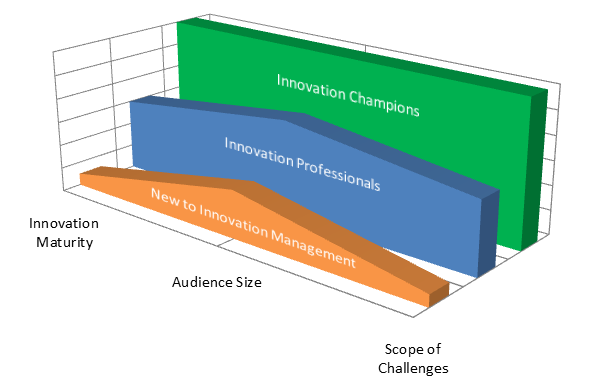
Generally speaking three aspects mainly influence the success of new innovation programs:
- Your innovation maturity
- Have you started innovation initiatives in the past?
- Are your employees familiar with the concept of submitting ideas and commenting on ideas of others?
- Your audience size
- Where is knowledge available today?
- Are you primarily working in silos, or are employees used to connect cross-divisional?
- Your scope of challenges
- What challenges are you facing today?
- How urgent do you need results?
Race drivers need the right strategy that matches their driving profile and experience to become successful. Similar, organizations need the right innovation strategy to implement an innovation program that matches their history, social and working culture and experience. Organizations that are new to innovation management usually focus on solving tactical objectives by involving smaller groups first, and widen the reach over time. The more successful you are the faster you can tackle more strategic challenges.
Do you already have a race car in your garage?
Author of the publication
