
Introduction Startups have scarce resources – heck, we all do. Startups run out of cash, but intrapreneurs and innovators can run out of goodwill if they a
Introduction
Startups have scarce resources – heck, we all do. Startups run out of cash, but intrapreneurs and innovators can run out of goodwill if they are unable to show results. I was recently told about an innovation team who were made redundant because they weren’t contributing to the bottom line. Perhaps short-sighted, but times are tough and business survival is paramount.
The challenge therefore is to understand progress, agree meaningful measures with the FD, and decide what to do next. This post suggests some ways of deciding what to prioritise.
Track Record
Over the last three years, I have worked with entrepreneurs and innovators to harness their ideas. Most recent examples:
- A Consultant Surgeon who wants to set up a global learning platform for the discipline in which he is an expert;
- A female founder who wishes to pivot from her existing business to establishing a new wellbeing event;
- A pair of co-founders who want to bring to market a lamp which speeds up recuperation from illness and injury; also applicable to social care, and prison environment;
- An online marketplace for property rentals.
By using the Business Model Canvas and Value Proposition Canvas, Founders and innovators start out by thinking about how to make money, and be open to the idea of pivoting the idea once a monetisable customer problem has been identified.
For example, I recently worked with a ‘Healthtech’ entrepreneur to bring a cleaning substance based on nanotechnology to market – could it be delivered as a service instead of a product?
Some more light-hearted ideas which have been put to the test in Customer Development exercise include:
- Sliced butter (think sliced cheese, and named ‘Butter by Far’); students are interested, but older couples definitely not – one glance from them made a lasting impact!;
- Off-beat funerals involving fireworks (called ‘Pyro-death-nics’); humans are interested, but pet-owners a strict no-no for sending their loved one into space, and;
- An ethical ISP (consumers aren’t interested); they care about price and speed – but consumers were non-plussed by an ethical differentiator.
The tremendous thing about these exercises is that in an hour, budding entrepreneurs were able to gather meaningful feedback – both positive and negative.
Frameworks for making decisions`
Given the scarce resources of a startup, how can startups and early-stage innovators make effective decisions which minimise waste, prioritise what needs to be done, and maximise value-add?
In the Dot-com bubble, startups spent enormous sums to create first-mover advantage, but this assumed that they knew what customers wanted. The next section aims to provide high-level guidance to entrepreneurs on what activities to be doing at what stage, when developing an idea.
Product Adoption Curve and the three ‘Fits’
This fun cartoon by Tom Fishburne illustrates Geoffrey Moore’s product adoption curve and “chasm”, which frames the challenge faced by entrepreneurs. If the money is to be made with the early and late majorities, how can we get there?
The premise is that innovators and early adopters value even unpolished solutions because they address issues not presently solved – and can be willing to co-create a solution. This helps reduce market risk and product risk, because you’re making something that people want. This translates into a way to turn initial traction from “problem-solution fit” into “product-market fit” and therefore scale and profits and sustainability.
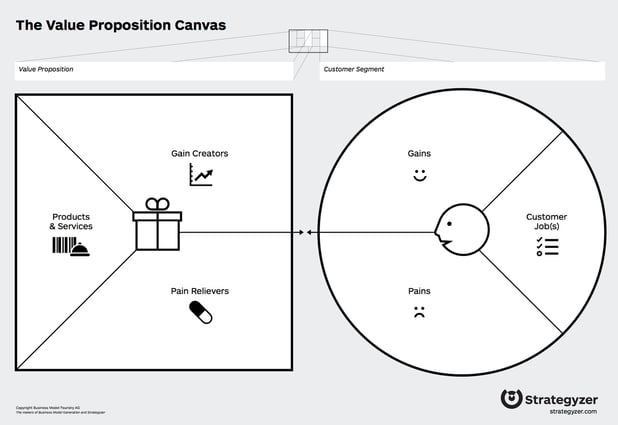
Source: https://strategyzer.com/canvas/value-proposition-canvas
According to Strategyzer the following stages are important:
1. Problem-Solution Fit
- this occurs when you have evidence that customers care about certain jobs, pains, and gains. At this stage you've proved the existence of a problem and have designed a value proposition that addresses your customers' jobs, pains and gains. Unfortunately, you still do not have clear evidence that your customer really care enough about your value proposition enough to buy it.
2. Product-Market Fit
- occurs when you have evidence that your value proposition is actually creating value for customers by alleviating their pains and creating the gains they desire. Your product or service is beginning to gain traction in the market and you've gone through the long and iterative process of running tests that have validated and invalidated the various assumptions underlying your value proposition.
So, does your idea solve a customer problem? If not, can you leverage your idea to discover a problem that a customer will pay you for – and pivot to that? If so, is there a big enough market out there for you to build a business on the back of?
Is everyone on the bus?
As Tim highlighted in his post, a Eric Ries defines a startup as a "human institution designed to create a new product or service under conditions of extreme uncertainty." The challenge for any intrapreneur is to get everyone else to realise the uncertainty when they are expecting you to execute against a hypothetical plan.
It could be that folk have politely nodded and said “we understand”, but have they made the emotional adjustment and understood the potential impact on their own plans and performance metrics which will ensue when you want to pivot? Do they ‘get it’?
Author of the publication
