
Innovation Employee Engagement
Learn how Polpharma Group effectively manages a large-scale employee innovation program with a small team, fostering engagement & cultural transformation.
How do you run an employee innovation programme for 6,200 people with a team of 1 (and a half)?
At our scale, many companies would grow the central innovation team. At Polpharma Group, we do it differently. Two of us, an innovation manager and a project manager, one full-time and one half-time, run Leonardo, our employee innovation programme, for more than 6,200 people. What makes it work is a network of colleagues who carry the programme, and communication that every market understands. I shared this approach at the HYPE Exchange in Paris in June 2026.
Why is innovation hard in a company like ours?
Polpharma Group is one of the largest pharmaceutical companies in Central and Eastern Europe, operating across diverse markets and cultures, with 8 manufacturing sites in Poland and Kazakhstan. A central team of our size cannot coach every idea on its own. And six years ago, when we started the programme, our employees weren’t naturally receptive to change.
How does a team of 1.5 reach 6,200 people?
We built a network instead of a department. 34 Innovation Leads give 10% of their time to the programme, with Leonardo written into their yearly goals, and our Innovation Leads Academy trains them. They work in six transformation groups, from innovation project management and reporting to Leonardo 4.0, an AI agent and a prompt-based system that helps colleagues submit better ideas. Since May 2026, 9 local coordinators have been supporting Leonardo across 12 countries: Kazakhstan, Uzbekistan, Kyrgyzstan, Latvia, Lithuania, Estonia, Switzerland, Bulgaria, the Czech Republic, Slovakia, Germany and Spain. Their role is new, so we haven’t set a share of their time yet.
What role does internal communication play?
It is the central team's main job, and the message changes as the programme matures. At launch, it was "Change the world with Polpharma!" Later, we celebrated "Leonardo's Superheroes". 2023 became a year of dialogue, with discussion on the HYPE platform at the centre of how ideas develop. In 2022, the Leonardo internal communication campaign won a Gold Stevie at the International Business Awards. This year, our new campaign, "Veni. Vidi. Da Vinci.", is shortlisted for the European Excellence Awards 2026 in the Internal Communication category. In 2025, Leonardo received 149% more submissions than in 2024.
Now Leonardo is rolling out across the whole Polpharma Group, and we needed a common language for innovation that is understood in countries such as Kazakhstan, Bulgaria and Latvia, as well as in Germany and Spain. Our new communication formula is rock and roll: you need to be a rebel while questioning the status quo! Our kick-off event was organized around rock and roll, with local music hits from every market, agenda in the form of a festival line-up and even some of the local General Managers wearing leather jackets instead of a suit.
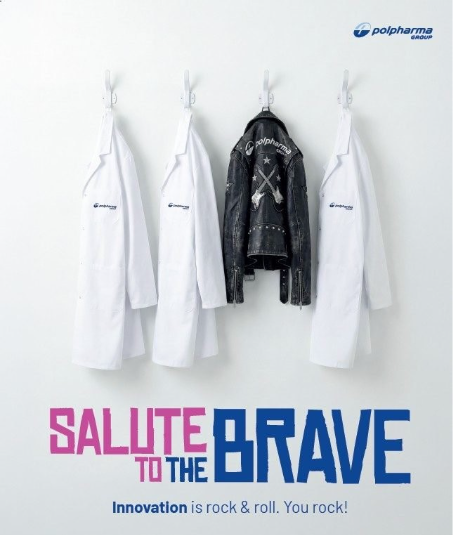
"Salute to the brave": this year's Leonardo roll-out campaign. Image: Polpharma Group.
Why does top management support matter?
Leadership commitment is one of our crucial success factors, and it is visible on the platform. At the Leonardo Gala 2025, where we recognise idea submitters, business owners and the teams that implement ideas, our CEO, Sebastian Szymanek, received an award as the most active commenter on the HYPE platform. When employees see top management reading and discussing their ideas, it encourages them to take part and builds engagement. At the Gala, he thanked colleagues "for the passion and courage to fight in order to keep this project going".
What has changed in six years?
Since the programme began in 2020, colleagues have submitted more than 1,400 ideas, 72 have been implemented, more than 600 others have helped develop them, and more than 1,500 have engaged through the platform. Today, 98% of our employees know the programme. We measure three kinds of impact: engagement and culture, portfolio health, and business impact, which covers time savings, cost savings, additional income and work effectiveness. The engagement and culture measures are as important as the others, if not more. In October 2026, Leonardo was one of the practice examples in "Innovation Management in Practice", the benchmark report from the Innovation Council of the Polish Confederation Lewiatan, launched at EFNI (European Forum of New Ideas) 2026 in Sopot, where I spoke on the panel.
One Leonardo idea turned gelatin waste from a disposal cost into a source of income. Instead of paying to dispose of it, the colleagues behind the idea found a company that is buying the waste to make the pellets used as ammunition in the game of paintball. This gave the material a second use, avoided disposal costs and generated revenue.
Our “Save 1 Hour” challenge ran for three months, until 30 October 2026. Employees submitted 65 ideas, and 54 of them are now in the concept phase. If fully implemented, they could save us around 150,000 working hours a year. This time could be reinvested in development and innovation initiatives that often get postponed because of other priorities and daily tasks. Employees estimated how much time their idea could save for the people affected: an individual, a team, a department or all employees and how often the described task or problem occurred (daily, weekly, monthly or annually). We then multiplied the estimated time saving by the number of occurrences per year to calculate the potential annual saving for each idea.
The clearest sign that our culture and mindset have changed is how employees respond to new ideas. Six years ago, the answer was "It can't be done." Today it is: "Let's figure out together how we can make it happen." This shift from questioning whether something is possible to exploring how to make it possible is one of the most meaningful outcomes of our innovation journey. Innovation is now an integral part of our organisational culture and one of the key pillars of the company's growth.
How is AI changing the ideas colleagues bring?
50 of the 65 Save 1 Hour ideas are about digitalisation: automating our own work with AI, including building agents. It shows that AI adoption across our company is already high, and people use AI-enabled tools and features in their daily work. At the same time, there is a clear appetite to go further. Colleagues are looking for opportunities, projects and support from our Digital team to apply AI at a more advanced level, particularly in analytical and research work. Leonardo 4.0 supports this from the start: an AI agent and a prompt base help colleagues shape an idea before they submit it.
What can other programme leads take from this?
- Build a network before you build a team: Innovation Leads and local coordinators carry the programme where a central team can't.
- Give volunteers real time, put the programme in their goals, and develop their innovation management skills with proper training.
- Change the message as the programme matures, from launch to recognition to dialogue.
- Bring top management onto the platform: when leaders comment on ideas, employees take part.
- Use focused challenges, like Save 1 Hour, to point ideas at what the business needs now.
- Find words for innovation that travel across countries and cultures.
- Measure culture alongside business impact, and report both.
For the story of our Innovation Leads Academy, read Top 5 Corporate Innovation Challenges: Real Lessons from Practitioners.
Images courtesy of Polpharma Group. Photo of Monika Jaslowska at the Leonardo Gala 2025: Olga Rainka.
How HYPE supports programmes like Leonardo
Polpharma runs Leonardo on the HYPE platform, where colleagues submit, discuss and develop ideas, and where top management joins the discussion. See how HYPE supports innovation leaders in pharma and life sciences.
Frequently asked questions
How many people run Polpharma's Leonardo programme?
A central team of 1.5: an innovation manager full-time and a project manager half-time, supported by 34 Innovation Leads who give 10% of their time and, since May 2026, by 9 local coordinators across 12 countries.
How does Polpharma measure innovation impact?
In three areas: engagement and culture, portfolio health, and business impact, which covers time savings, cost savings, additional income and work effectiveness.
How does top management support Leonardo?
Leadership commitment is one of Leonardo's success factors. At the Leonardo Gala 2025, Polpharma Group CEO Sebastian Szymanek received an award as the most active commenter on the HYPE platform, which encourages employees to take part.
What is Leonardo's formula for the group-wide roll-out?
A common language for innovation across markets, summed up as rock and roll: be a rebel while questioning the status quo.
Author of the publication
