IT Leader
Enable Innovation and Transformation Without Adding More Complexity
HYPE helps IT leaders support innovation, AI, transformation, and improvement initiatives with one secure, configurable, and integrated platform — giving business teams the workflows they need while giving IT the governance, scalability, and control required for enterprise environments.
.png?width=807&height=807&name=Untitled%20(2000%20x%202000%20px).png)



.png?width=250&height=56&name=Group%20(1).png)



The Reality of the Role
IT is Expected to Enable Business Transformation While Reducing System Complexity
Innovation, AI, digital transformation, and operational improvement initiatives are increasingly business-led. But IT is often responsible for making sure these initiatives are secure, scalable, integrated, governed, and supportable.
Without the right system, business teams turn to spreadsheets, disconnected tools, local workflows, and manual reporting. This creates fragmented data, inconsistent governance, integration gaps, security concerns, and limited visibility into what is happening across the organization.
HYPE helps IT leaders provide a structured innovation management system that business teams can use to manage ideas, opportunities, initiatives, workflows, and outcomes — while IT maintains confidence in architecture, integration, access control, reporting, and scalability.

Common Challenges
- Innovation and transformation initiatives are spread across too many tools, spreadsheets, and local processes.
- Reporting is inconsistent because data is fragmented across teams and systems.
- IT is asked to support AI and digital initiatives without a clear portfolio view.
- Manual processes create operational overhead for both IT and business teams.
- Leadership expects visibility into progress, risk, and outcomes across transformation and innovation initiatives.

How HYPE Helps IT Leaders
1. Capture innovation & transformation needs in one system
Support idea collection, opportunity discovery, transformation initiatives, and improvement programs on one connected platform. Every input enters with common data, users, and access controls, so nothing sits in an isolated spreadsheet or a rogue tool. You give the business one governed place to work instead of a scattered set of local trackers. This reduces the number of systems you provision, secure, and support. The result is fewer entry points to manage and a single source of truth for the work IT is accountable for.
2. Evaluate platform fit & integration requirements
Assess how the platform connects to the environment you already run before rollout. HYPE supports REST APIs, SSO, and Microsoft ecosystem integrations including Teams, SharePoint, and Entra ID directory sync, plus BI connectivity to Power BI and Tableau. You validate integration fit, user management, and data flow against your standards up front — not after deployment. This keeps the platform aligned with existing systems rather than becoming another disconnected island. You make a defensible decision backed by clear technical criteria.
3. Prioritize consolidation & governance initiatives
Compare where consolidation delivers the most value across teams, cost, and compliance risk. Direct effort toward replacing the disconnected tools that add the most overhead and the least oversight. You focus on the initiatives that cut maintenance cost and close governance gaps — not on requests that add another point solution. Centralized portfolio views help you weigh each move against resources and expected impact. This turns a crowded backlog of tool requests into a set of clear investment decisions.
4. Develop scalable, configurable workflows
Adapt workflows, forms, fields, stages, approval paths, and governance models through configuration — not heavy custom code. Your teams can own and change these as business needs shift, without triggering new development projects or vendor dependency. Role-based access and consistent governance apply across programs and business units from one codebase. This lowers total cost of ownership and keeps oversight consistent as adoption grows. You meet different business requirements from a single, supportable operating model.
5. Execute, integrate & prove platform value
Move approved use cases into production, connect them to enterprise systems, and give leadership visibility across every initiative. Centralized reporting shows progress, ownership, risk, and outcomes in one place — replacing manual, one-off reporting. Low-code extensibility lets you absorb adjacent processes like IP management, risk management, or ISO 56000 without standing up separate systems. You scale the platform with the business instead of watching sprawl return. This is how IT proves the value of one governed platform: lower cost, tighter control, and measurable outcomes.
From Insight to Measurable Business Impact
Leading organizations use HYPE to solve real business challenges — from reducing cost and improving efficiency to accelerating growth, engaging employees, and driving transformation.



AI Support
AI Support for Faster Analysis and Better Decision Support
HYPE uses AI-supported capabilities to help teams reduce manual effort, identify patterns, and prioritize ideas, opportunities, and initiatives faster.
AI can support:
- Idea and initiative summaries to speed up review
- Smart categorization across topics, business units, technologies, and priorities
- AI-supported evaluation workflows to reduce manual review effort
- Innovation Graph analysis to identify patterns and relationships across data
- Faster reporting and insight discovery across portfolios and initiatives
AI helps business teams process more information faster while keeping people in control of evaluation, prioritization, governance, and final decisions.
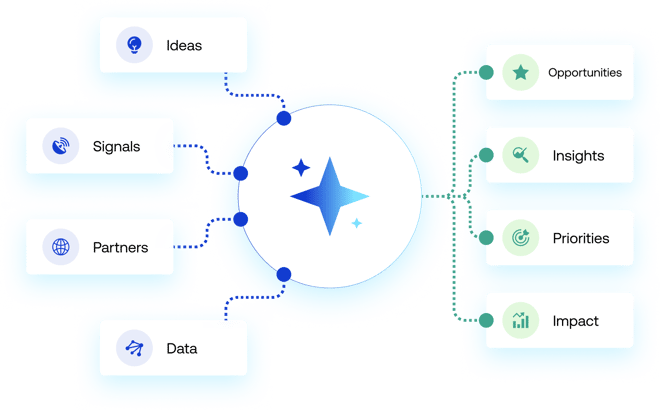
Enable Innovation and Transformation Without Adding More Complexity
Replace fragmented workflows, disconnected reporting, and unmanaged local processes with one enterprise-ready platform for innovation, AI, transformation, and measurable business impact.