Strategy Leader
Turn Strategic Priorities into Measurable Business Impact
HYPE helps strategy leaders identify the right opportunities, prioritize strategic initiatives, align teams around business priorities, and track progress from strategic intent to measurable outcomes.


.png?width=200&height=80&name=TD%20Bank%20White%20(2).png)





The reality of the role
Strategy Fails When Priorities Do Not Turn into Action
Strategy leaders decide where to focus, what to prioritize, and how to turn goals into business outcomes.
But in many organizations, priorities become disconnected from the initiatives and investments meant to deliver them. Teams work in silos. Initiatives compete for attention. Reporting shows activity instead of progress, value, and impact.
The result is strategic drag: too many initiatives, unclear ownership, limited visibility, and difficulty proving which work moves the business forward.
HYPE helps strategy leaders align initiatives, portfolios, and outcomes to priorities — so resources focus on the work that matters most.
%20(4).png?width=660&height=514&name=Untitled%20(2000%20x%202000%20px)%20(4).png)
Common Challenges
- Strategic priorities are not consistently translated into clear initiatives.
- Leaders lack visibility into which initiatives support which priorities.
- Reporting does not clearly show progress against strategic objectives.
- High-value opportunities are delayed, duplicated, or lost.
- It is difficult to connect strategy work to growth, savings, efficiency, customer value, or transformation outcomes.

How HYPE Helps Strategy Leaders
1. Capture opportunities aligned to strategy
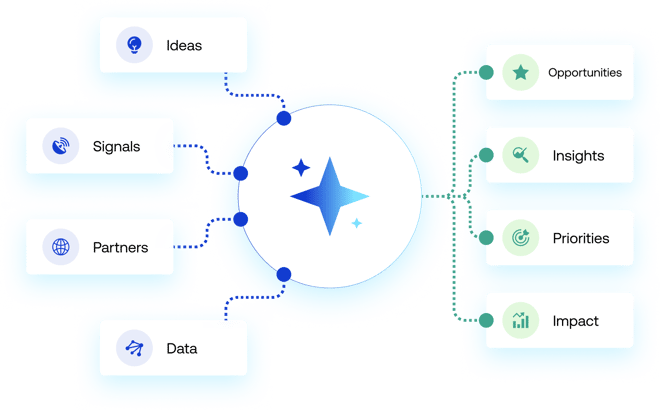
Collect ideas, market signals, trends, customer needs, and business initiatives in one structured system. Tie every submission to a growth area, transformation theme, or strategic objective from the start, so nothing enters the portfolio disconnected from the plan. You build a pipeline that reflects where the business is headed — not a backlog of unfocused requests.
2. Evaluate strategic fit & value potential
Assess each initiative against strategic fit, value potential, feasibility, and risk using clear criteria and configurable review workflows. Expert input and AI-driven insights help you separate high-return work from low-value activity before capital is committed. You make faster, more defensible investment decisions — and stop funding initiatives you can't justify.
3. Prioritize the highest-value initiatives
Compare initiatives across business units against strategic goals, available resources, and expected impact in one portfolio view. Direct investment toward the work with the strongest return and manageable risk — and cut what won't move the numbers. You keep the portfolio focused on outcomes that matter to growth, cost, and execution speed.
4. Develop execution-ready initiatives
Turn selected opportunities into structured initiatives with clear ownership, business cases, and supporting evidence. Stage-gate workflows guide each one from concept to execution while aligning executives, business units, strategy, and transformation teams around the same decisions. You reduce the gap between strategic intent and delivery — and keep stakeholders moving in one direction.
5. Implement and prove business impact
Move approved initiatives into action and track ownership, milestones, risks, and progress across the portfolio in one transparent view. Connect execution to measurable outcomes — revenue potential, cost savings, efficiency gains, and transformation progress. You give leadership clear visibility into what the strategy delivered, backed by numbers.
From Insight to Measurable Business Impact
Leading organizations use HYPE to turn strategic priorities into tangible results — from growth and efficiency to cost reduction, innovation, and transformation.





AI Support
AI Support for Faster Prioritization and Strategic Decision-Making
HYPE uses AI-supported capabilities to help teams analyze opportunities, identify relationships, reduce manual review effort, and support better prioritization decisions.
AI can support:
- Smart categorization by strategic priority, business unit, value driver, or theme
- AI-supported evaluation workflows to support faster prioritization
- Innovation Graph analysis to identify patterns and relationships across initiatives
- Faster reporting and insight discovery across strategic portfolios
- Opportunity and initiative summaries to speed up review
AI helps teams process more strategic input faster while keeping people in control of evaluation, prioritization, and final decisions.
Turn Strategy into Prioritized Initiatives and Measurable Outcomes
Replace scattered initiatives, inconsistent prioritization, and manual reporting with one system for strategic alignment, portfolio visibility, decision-making, and business impact measurement.